Food security means everyone has reliable access to enough, affordable, and nutritious food. It depends on availability, access, utilization, and stability. In contrast, food sovereignty focuses on people’s right to define their own food systems. It prioritizes local control, culturally appropriate crops, and sustainable farming methods.
In 2025, the discussion of food sovereignty and food security is more urgent than ever. This is true globally and in regions like Gilgit-Baltistan. Climate change is disrupting food production worldwide. It causes prolonged droughts, devastating floods, and unpredictable growing seasons.
Gilgit-Baltistan has faced uneven climate change events. These include flash floods and dry winters. Local soils, glacial meltwater for irrigation, and different crop varieties offer a blueprint for betterment. However, these practices face pressure from climate shifts. They also face declining water availability and the temptation of market-driven cash crops.
Unstable Global Food Security.
Food security relies on a complex network of global supply chains. These chains can deliver food worldwide in days. This system has expanded food choices. It has also helped regions with limited farming. Yet, it is fragile, a fact Gilgit-Baltistan knows well.
The mountainous region restricts large-scale farming. Gilgit-Baltistan relies heavily on imported staples. For example wheat, rice, sugar, and edible oil. Any disruption can quickly cause shortages and rising prices. This could be a landslide closing the Karakoram Highway or political unrest in other countries.
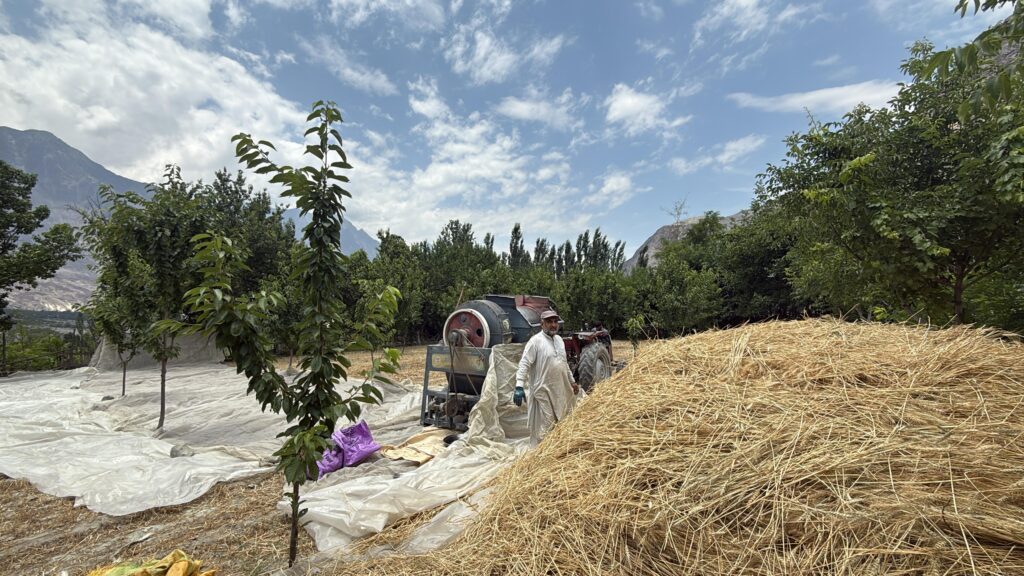
The 2022 floods in Pakistan showed this fragility. In Gilgit-Baltistan, local fields were mostly closed. Transportation routes from the south were cut off for weeks. This caused imported staples to disappear from markets. Residents with access to locally grown barley, potatoes, and apricots did better. However, this food was not enough to meet the nutritional needs of the whole population.
Today, climate shocks and market volatility are more frequent. Gilgit-Baltistan’s situation shows why food security is unstable in a globalized system. The region must strengthen local production. It should also invest in Climate-Resilient Crops and build community-based storage systems. Without these, a small disruption can become a food crisis. The region’s experiences echo a global realization. In an age of uncertainty, food systems need to be both local and global.
Food Sovereignty-The Rising Movement.
Food sovereignty is about communities controlling their own food systems. It focuses on local food production and keeping indigenous crops. Communities decide what to grow based on their needs, not market demands.
Gilgit-Baltistan has a long history of local farming. Families there grow traditional crops like apricots, barley, and buckwheat. They use simple irrigation and save seeds passed down through generations. This way of life is now under pressure.
Climate change is melting glaciers. This shrinks farmland and shortens planting seasons. The glaciers feed irrigation channels. Wheat shortages and price hikes have caused protests across the region.
Communities are fighting back. Programs like ETI-GB and AKRSP are helping. They build greenhouses, improve small roads, and teach new, local-friendly farming techniques. This helps families eat what they grow.
Difference and Why Food Security & Food Sovereignty Matters?
The concepts of food security and food sovereignty often overlap in daily life. However the difference between them shapes how communities prepare for the future. For many households in Gilgit-Baltistan, food has historically come from a mix of local harvests and imported staples. This system works well in stable years. But access to imports becomes uneven during a crisis. This happens when heavy snowfall blocks roads, fuel shortages slow transport, or prices spike.
In Gilgit-Baltistan, safeguarding traditional apricot orchards, terrace farming, and glacier-fed irrigation systems is not just about cultural activity. It also ensures that in times of crisis, people can feed themselves. They don’t have to rely entirely on outside sources.
The difference between the two concepts matters. One can exist without the other. A community might have short-term food security by importing cheap grains. However, if it loses the ability to produce its own food, it becomes vulnerable to supply chain shocks. Similarly, focusing only on sovereignty without enough yields could leave gaps in nutrition and availability.
Trending Global Solutions That Must Be Applied Locally.
Climate-Smart Agriculture (CSA):
A farming approach designed to help agriculture to adopt climate change while reducing its negative impact on the environment. This includes using farming methods that can handle droughts, floods, temperature changes, and other climate change effects.
Drip Irrigation & Water Harvesting:
Drip irrigation is a water efficient farming method that delivers water directly to plant roots through a network of pipes and tubes, minimizing waste via evaporation.
Renewable Energy Farming:
Solar-powered irrigation pumps and cold storages for sustainable environment.
What can be a good Policy for Global Solidarity in 2025?
For Gilgit-Baltistan, effective agricultural policy in 2025 must connect local needs with broader support like help from within Pakistan and through global initiatives. Locally, policy should focus on investments in climate-resilient infrastructure. This means upgrading the Karakoram Highway to ensure year-round food access.
It also means expanding cold storage facilities to reduce post-harvest losses. Government-backed programs are essential. They should protect and promote indigenous crops, from high-altitude potatoes to heritage apricots. This preserves both biodiversity and food sovereignty.
Water security policy is another key factor. As glacier melt speeds up, coordinated planning is essential. This planning should involve local councils, provincial authorities, and scientific institutions. It will ensure the sustainable use of meltwater through modernized kul irrigation systems.
Final Thoughts.
In 2025, Gilgit-Baltistan’s struggle between food security and food sovereignty reflects a global reality; moreover, resilience depends on both. Climate change, fragile supply chains, and rising costs make it clear that relying on imports is risky, whereas focusing only on local production can leave gaps in nutrition.
Consequently, the region’s future lies in between global innovations like climate-smart farming, water harvesting, and renewable energy with traditional practices such as glacier-fed irrigation and indigenous crops. By securing both immediate access to food and the long-term ability to produce it locally, Gilgit-Baltistan can withstand crises while preserving its agricultural heritage.