
Climate-Smart Urban Farming Model for Gilgit & Chitral
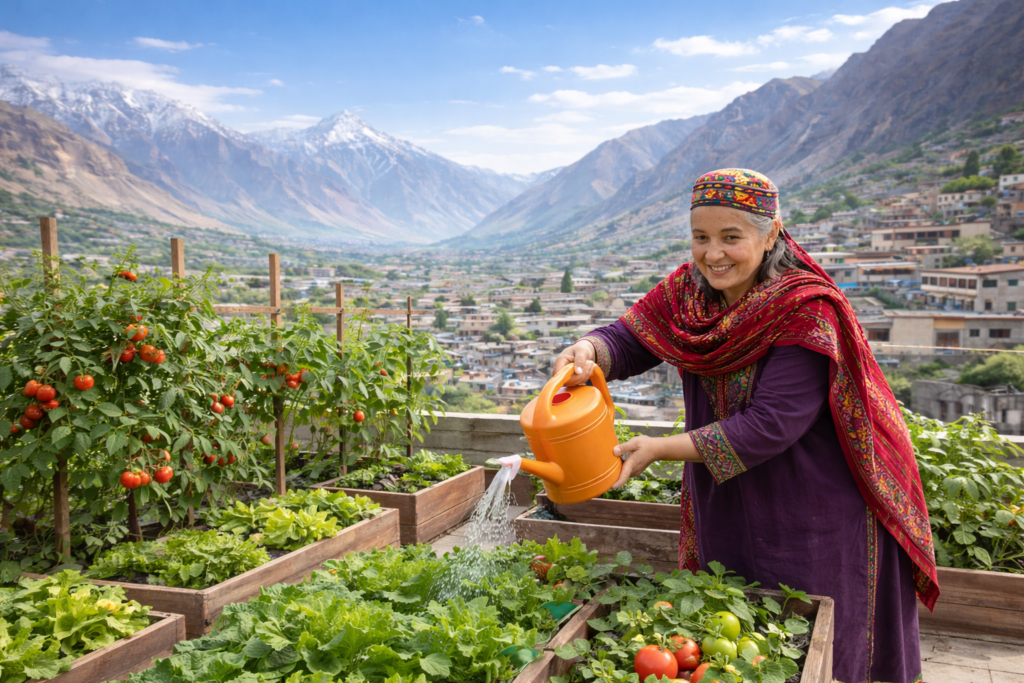
Gilgit-Baltistan (GB) and Citral is among Pakistan’s most climate-vulnerable mountain regions. According to the United Nations Development Programme (UNDP) and Germanwatch Global Climate Risk Index, Pakistan consistently ranks among the countries most affected by extreme weather events. The regions specifically faces:
- Glacier melt and Glacial Lake Outburst Floods (GLOFs)
- Erratic rainfall and flash floods
- Short growing seasons (April–September window)
- Rapid urbanization with shrinking cultivable land
- Poor irrigation infrastructure
In urban centers like Gilgit, Hunza, Skardu, & Chitral Town traditional open-field farming is increasingly unsustainable due to land fragmentation, climate variability, poor irrigation system, and rising vegetable import dependency.
The Regional Challenge: Why Traditional Farming Is Failing
Limited Cultivable Land
Urban expansion has reduced per-household agricultural landholding. Most families in city populations possess either:
- No farmland
- Very small backyard plots
- Rooftop, Balconies, Verandas, concrete spaces
Rising Food Costs
A household in Gilgit City spends approximately PKR 20,000 per month on vegetables, largely sourced from down-country markets (Punjab/KPK). Transport costs, climate shocks, and supply chain disruption increase prices.
Climate Risk Exposure
Traditional farming depends on:
- Predictable snowfall patterns
- Glacier-fed irrigation channels
- Stable seasonal cycles
However, the regions experiencing:
- Earlier snowmelt
- Glacial Lake Outburst Floods (GLOFs)
- Irrigation shortages
- Late spring frost events
- Heat stress during peak summer
- Cloudburst & Flash Floods
This makes open-field vegetable farming economically risky.
The Agriclime Climate-Smart Urban Agriculture Model
Core Model: Protected, Space-Efficient Kitchen Gardening
Instead of replacing agriculture, the model repositions farming from land-based to space-based systems, utilizing:
- Rooftops
- Courtyards
- Balconies
- Community shared spaces
Low-Tunnel & Protected Cultivation
Using affordable plastic low tunnels:
- Extends growing season
- Protects crops from frost
- Reduces pest pressure
- Improves yield consistency
- Year round cultivation
Container & Vertical Gardening Systems
Ideal for dense urban areas like Gilgit, HUnza, Skardu, and Chitral Town where soil access is limited.
Advantages:
- Requires 70–80% less land
- Reduces soil-borne disease
- Enables rooftop food production
- Allows crop rotation in small spaces
Suitable crops:
- Spinach
- Lettuce
- Coriander
- Tomatoes
- Chilies
- Mint
- Cabbage
Climate-Resilient Crop Selection
Focus on:
- Short-duration varieties
- Cold-tolerant greens
- Drought-tolerant legumes
- Drought-tolerant legumes
This aligns with climate adaptation strategies promoted by the Food and Agriculture Organization for mountain agriculture systems.
Organic Composting & Waste Recycling
Urban households generate biodegradable waste that can be converted into compost.
Benefits:
- Reduces fertilizer cost
- Improves soil fertility
- Reduces urban waste burden
- Lowers carbon footprint
Economic Comparison: Kitchen Gardening vs Traditional Farming
Monthly Savings Potential
If a household spends PKR 20,000 monthly on vegetables:
Even replacing 50% through kitchen gardening =
PKR 10,000 savings per month
= PKR 120,000 per year
Return on investment can occur within 1–2 growing seasons.
Why Kitchen Gardening Is More Suitable for Densely Populated Regions
Land-Neutral Farming
Does not require agricultural fields & large amount of water.
Climate Adaptation
Reduces exposure to frost, floods, droughts, and erratic rainfall.
Women & Youth Empowerment
Urban women and youth can manage:
- Seed sowing
- Harvest cycles
- Micro-marketing surplus produce
Nutrition Security
Improves access to:
- Fresh leafy greens
- Chemical-free vegetables (home based organic compost)
- Off-season produce
Alignment with Climate Risk Reduction Strategies
The model supports:
- Disaster Risk Reduction (DRR)
- Climate adaptation
- Food system resilience
- Localized food security
It complements global frameworks promoted by:
- Green Climate Fund
- Adaptation Fund
- Global Environment Facility
These institutions prioritize:
- Community-based adaptation
- Nature-based solutions
- Climate-smart agriculture
Conclusion: The Future of Climate-Resilient Farming
Traditional farming in densely populated Gilgit-Baltistan is increasingly vulnerable to climate shocks and land scarcity. Large expensive greenhouse structures are not feasible for most households.
Kitchen gardening, when modernized through:
- Protected cultivation
- Vertical systems
- Climate-resilient crop planning
- Organic nutrient management
becomes a low-cost, high-impact, climate-adaptive agricultural model
For regions like Gilgit, Hunza, Skardu, & Chitral Town, this approach is not merely an alternative, it is a necessary transition toward resilient urban food systems.
Agriclime.earth’s model positions Gilgit-Baltistan & Chitral as a leader in mountain-based climate-smart urban agriculture, aligning local innovation with global climate finance priorities.